This guide explains the practical difference between the two, how each performs in Toronto’s specific climate, and how to determine which one makes sense for your home.
What Is Traditional Stucco?
Traditional stucco — sometimes called direct-apply or hard-coat stucco — is a cement-based plaster applied in multiple coats directly over a substrate. The substrate can be masonry (brick, block, concrete), wire lath over framing, or an existing wall surface. The system consists of a scratch coat, a brown coat, and a finish coat, producing a hard, durable exterior shell.
Traditional stucco has been used on Toronto homes for over a century. It is the system you see on older homes throughout North York, The Beaches, Cabbagetown, and many pre-war neighbourhoods across the city.
Installed cost in Toronto: $12 – $20/sq ftnderlying wall is likely already exposed to moisture behind the affected section. This requires repair before the next freeze season.
What Is EIFS?
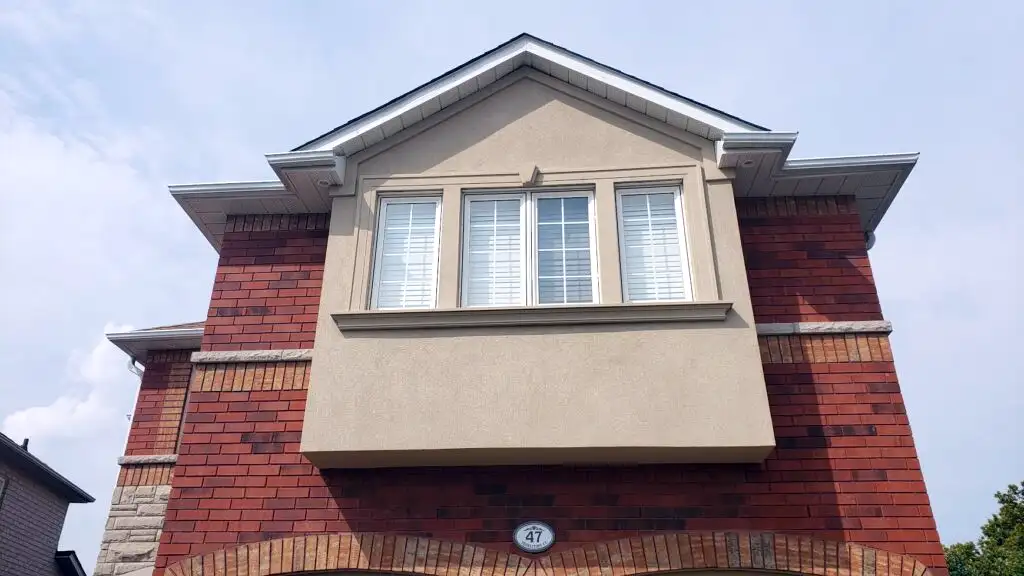
EIFS is an exterior wall cladding system that includes a layer of rigid EPS (expanded polystyrene) foam insulation attached to the substrate, followed by a fibreglass mesh-reinforced base coat, and an acrylic finish coat. The foam layer is what differentiates it from traditional stucco — EIFS is a building envelope system, not just an exterior finish.
In the GTA, EIFS and stucco are used interchangeably in common speech. When a homeowner says they want “stucco,” most Toronto contractors understand this to mean EIFS — the foam-and-finish system that has become the standard for exterior cladding upgrades over the past 30 years.
Installed cost in Toronto: $22 – $35/sq ft
Head-to-Head Comparison
| Factor | Traditional Stucco | EIFS |
|---|---|---|
| Installed cost (Toronto) | $12 – $20/sq ft | $22 – $35/sq ft |
| Insulation value added | Negligible (R-0.2) | R-5 to R-10 (2″–3″ foam) |
| Flexibility in freeze-thaw | Lower — more prone to cracking | Higher — acrylic finish is flexible |
| Impact resistance | High (hard surface) | Moderate (foam can be dented) |
| Repair cost | Lower per section | Moderate per section |
| Lifespan (Toronto climate) | 20–30 years | 30–50 years |
| Energy savings over time | Minimal | Significant |
| Best for | Masonry restoration, heritage properties | Full exterior re-clad, energy upgrade |
| Appearance options | Sand, dash, float, smooth | Sand, dash, float, smooth, marble fine |
| Moisture management | Good (breathable) | Good (with proper drainage detailing) |
How Toronto’s Climate Affects the Choice
Toronto’s climate creates specific performance demands that make EIFS the recommended choice for most exterior re-clad projects.
Freeze-Thaw Performance
The single biggest performance differentiator in Toronto’s climate is flexibility. Traditional stucco is a rigid, cement-based system. EIFS has an acrylic finish coat that retains flexibility through the temperature range. As the wall assembly expands and contracts through Toronto’s −25°C to +35°C cycle, the flexible finish coat accommodates that movement without cracking at the rate that traditional cement stucco does.
This doesn’t mean traditional stucco cracks inevitably — properly specified traditional stucco with correct mix design can perform well. But EIFS has a meaningful advantage in freeze-thaw resistance.
Energy Performance
Older Toronto homes — particularly those built before 1980 — have very limited wall insulation. A standard brick exterior has an effective R-value under R-1. Adding 2 inches of EPS foam under the EIFS system brings the wall to approximately R-5 to R-6, which produces measurable energy savings year-round.
For homeowners who are re-cladding an older home anyway, EIFS delivers the insulation upgrade as part of the same project scope. The incremental cost of the foam over traditional stucco is typically recovered in 10–15 years through energy savings.
Heritage and Restoration Applications
For heritage properties, City of Toronto designated buildings, or projects where matching existing stucco is required, traditional hard-coat stucco is often the appropriate system. Heritage guidelines frequently specify materials appropriate to the period of construction — modern EIFS systems are generally not permitted on designated heritage exteriors.
Which System Should You Choose?
Choose EIFS if:
- You’re re-cladding an older home and want the energy upgrade alongside the appearance improvement
- Your project is a full exterior renovation rather than a targeted repair
- Long-term performance and minimal maintenance are your priorities
- You’re in a newer neighbourhood where EIFS is the standard
Choose traditional stucco if:
- You’re restoring or matching an existing traditional stucco system
- Your property has heritage designation or restrictions
- You’re doing targeted repairs that need to match existing hard-coat stucco
- Budget is the primary constraint and energy upgrade is not a goal
In most cases, the answer is EIFS. For GTA homeowners doing a full exterior re-clad, EIFS delivers better thermal performance, better long-term flexibility, and a superior finish quality to traditional stucco at a higher upfront cost that pays back over time.
What Alasya Construction Recommends
We’ve installed both systems across Toronto and the GTA since 2005, working with DuRock Alfacing, Durabond, and STO product lines. Our standard recommendation for full exterior re-clad projects is EIFS with 2-inch EPS foam — it consistently delivers the best combination of performance, appearance, and longevity for Toronto’s climate.
For repair projects, we match whatever system is in place — traditional stucco repairs go back with traditional materials, EIFS repairs with EIFS-appropriate products. Mixing systems in a repair creates interface problems that accelerate future failures.
See our EIFS and stucco installation services: Stucco & EIFS Toronto
Not sure which system is right for your home?
We’ll assess it at no charge!
Get pricing for your project: read Stucco Cost Guide
FAQ