
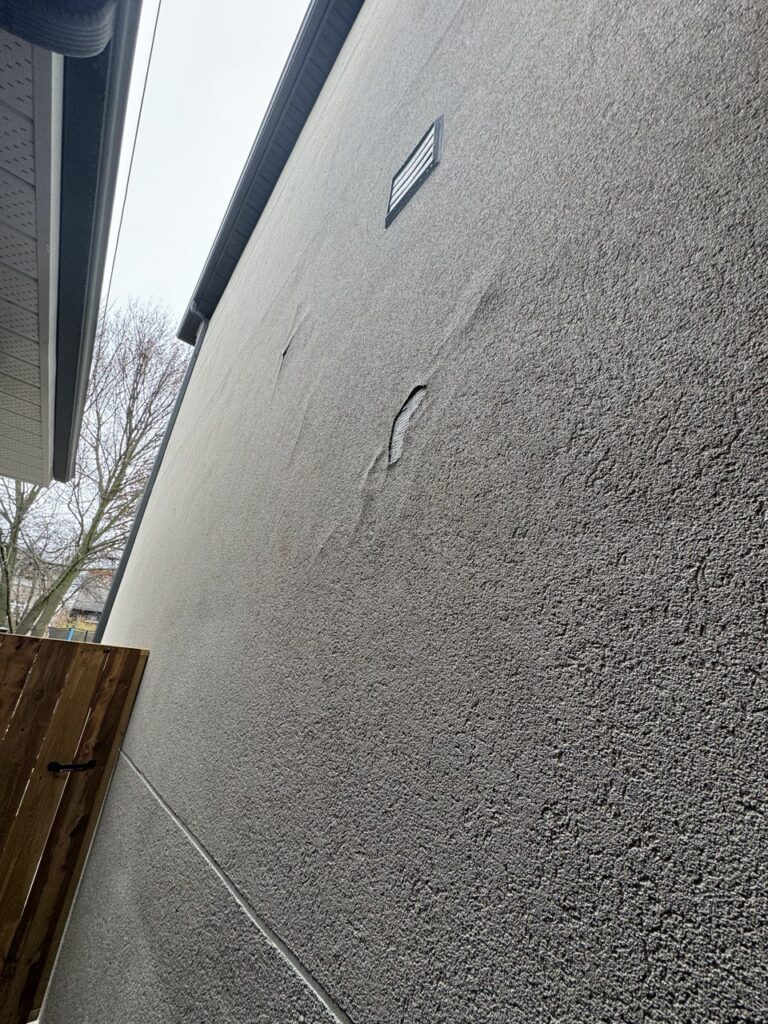
Knowing what to look for — and what each issue actually means — can save Toronto homeowners thousands in repair costs. This guide covers the seven most common signs of stucco failure, what’s causing each one, and what it realistically costs to fix.
1. Hairline Cracks at Corners or Around Windows
What it looks like: Fine cracks, usually under 1mm wide, running diagonally from window corners or at outside corners of the building.
What’s causing it: Normal thermal expansion and contraction. Stucco expands and contracts with temperature changes, and stress concentrates at corners and window openings where the geometry changes. Hairline cracks are common and not immediately alarming.
When it becomes a problem: When water enters the crack and freeze-thaw cycling widens it over multiple seasons. A hairline crack that has been stable for years is a monitoring issue. A crack that appears to be widening, or that shows water staining below it, warrants prompt attention.
Repair cost: $400 – $900 for isolated crack repair with texture matching.
2. Stucco That Sounds Hollow When Tapped
What it looks like: The surface looks intact but produces a hollow thud rather than a solid sound when you knock on it.
What’s causing it: The bond coat between the stucco finish and the substrate has failed. The stucco is still in place but is no longer adhered to the wall — it’s essentially held up by the surrounding sections and its own rigidity.
When it becomes a problem: This is an active failure. Delaminated stucco will crack and fall away, and the underlying wall is likely already exposed to moisture behind the affected section. This requires repair before the next freeze season.
Repair cost: $1,500 – $4,500 depending on the extent of delamination. Small delaminated sections can often be repaired by injecting epoxy adhesive and re-securing with pins. Larger sections require removal and full re-application.
3. Water Staining or Dark Streaks Below Joints
What it looks like: Vertical dark streaks running down the wall from a specific joint, window, or corner — particularly visible after rain.
What’s causing it: Water is consistently entering at a specific point — most commonly a failed caulk joint around a window, a missing or damaged flashing, or a cracked joint at a horizontal transition. The water travels down inside the wall assembly and stains the exterior as it exits.
When it becomes a problem: Water intrusion behind stucco creates conditions for mould growth, wood rot, and insulation degradation. Persistent staining after rain is never cosmetic — it indicates an active water pathway into your wall assembly.
Repair cost: $600 – $2,500 depending on the source and extent. Finding and sealing the entry point is critical — surface stain removal without fixing the source will not resolve the problem.
4. Efflorescence — White Powder or Chalky Deposits
What it looks like: White, powdery deposits or chalky streaks on the stucco surface, typically appearing in winter and spring.
What’s causing it: Mineral salts in the stucco or underlying masonry are being drawn to the surface by water movement through the wall. Efflorescence is always an indicator of water movement — it cannot appear without moisture travelling through the stucco.
When it becomes a problem: Occasional light efflorescence in early spring after a wet winter is common and can be brushed off. Efflorescence that reappears quickly after cleaning, or that covers large areas, indicates ongoing moisture movement that warrants investigation.
Repair cost: Cleaning alone is $200–$600. If underlying moisture movement is identified, repair cost depends on source.
5. Bulging or Blistering Sections
What it looks like: The stucco surface appears to be pushing outward from the wall — a visible bubble or bulge, sometimes with visible cracking around the edges.
What’s causing it: Moisture has entered the wall assembly and is trapped. The pressure of water expansion and vapour movement causes the stucco to push away from the substrate. In severe cases, this indicates significant water infiltration and potential damage to the underlying structure.
When it becomes a problem: Immediately. Bulging stucco should not be left through a freeze-thaw season. The moisture causing the bulge will freeze, the expansion will crack the section further, and what was a $2,000 repair can become a $6,000–$10,000+ wall repair project.
Repair cost: $2,000 – $8,000+ depending on extent and whether substrate damage has occurred.
6. Cracks at Penetrations — Outlets, Vents, Pipes
What it looks like: Cracking or separation specifically where stucco meets a pipe, electrical outlet, hose bib, or vent penetration.
What’s causing it: Sealant failure or absent sealant at the penetration. Metal penetrations expand and contract at different rates than the stucco around them, which shears the sealant joint over time. Once the sealant fails, water enters directly into the wall at one of the most vulnerable points — a pre-made hole.
When it becomes a problem: Penetration cracks are a common and underestimated source of water damage in Toronto homes. They’re typically small and easy to overlook, but they represent a direct water entry point at every single penetration on the building.
Repair cost: $150 – $400 per penetration for proper sealant remediation and stucco repair. Often found during a full perimeter inspection.
7. Sections Falling Away or Missing
What it looks like: Pieces of stucco have fallen off the wall entirely, leaving bare substrate — mesh, building paper, block, or wood framing — exposed.
What’s causing it: Accumulated freeze-thaw damage to delaminated sections, impact damage, or structural movement. Fallen sections have typically been in failure mode for some time before they detach.
When it becomes a problem: The moment the substrate is exposed. Exposed framing or insulation facing Toronto’s rain, snow, and freeze-thaw cycling will sustain significant damage in a short time. This is an emergency repair scenario.
Repair cost: $1,500 – $5,000+ per affected section. Substrate inspection and repair may add additional cost.
Repair vs Replace: How to Decide
The general guidance is: if repairs would address more than 30–40% of the total stucco area, full replacement is typically more cost-effective and produces a better result. Patching an ageing stucco system works in the short term but the age differential between new and old sections often produces visible inconsistencies as the patched areas and original areas age differently.
We assess each situation at no cost and give you a straight answer about whether repair or replacement makes more sense for your specific home and budget.
We work with DuRock Alfacing, Durabond, and STO systems and specify the exact product in every quote so you know what you’re getting before work begins.
See our stucco repair and installation services: Stucco & EIFS Toronto
Notice any of these signs on your home?
We provide written inspection reports with all estimates.
FAQ