What Is Repointing?
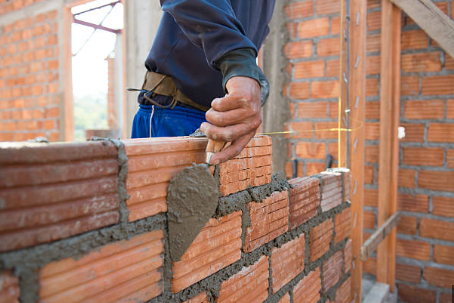
Repointing is the process of removing deteriorated mortar from the joints between bricks or stones and replacing it with fresh mortar. The name is straightforward: you are pointing the joints again (re-pointing).
It is the standard repair for any masonry wall where mortar joints have softened, crumbled, eroded, or cracked. It is the most common masonry maintenance service performed on Toronto’s residential and commercial building stock.
The process:
- Deteriorated mortar is mechanically removed to a depth of approximately 20mm using an angle grinder or oscillating tool
- Joints are cleaned of debris and dust
- Fresh mortar is mixed to match the original in colour, composition, and strength
- New mortar is packed into the cleaned joints in layers
- Joints are tooled to the appropriate profile once the mortar has partially set
When it’s needed: Any time mortar joints show visible deterioration — crumbling, gaps, erosion to a depth where the brick edge is exposed. Toronto homes built before 1980 often have mortar approaching end-of-life; many homes in the city’s established neighbourhoods are overdue.
What Is Tuckpointing?
Tuckpointing is a specific decorative technique — not simply a synonym for repointing. It involves applying two different coloured mortars to the joints: a base mortar that closely matches the brick colour, filling the joint nearly flush, and then a thin line of contrasting mortar (usually white or cream) applied along the centre of the joint with a narrow tool called a tuck.
The result creates the visual illusion of very fine, precise mortar lines on a wall that may actually have quite wide joints. It was common on 19th and early 20th century brickwork and is associated with Georgian and Victorian architecture — the style of many heritage properties in Toronto’s older neighbourhoods including Cabbagetown, Rosedale, The Annex, and parts of Riverdale.
The process:
- Joints are prepared as in standard repointing
- A base mortar matching the brick colour is applied and finished nearly flush
- A narrow groove is cut along the centre of the dried base mortar
- A contrasting fine mortar line is applied along the groove and finished proud of the surface
When it’s needed: Primarily on heritage or period properties where the original tuckpointing detail is deteriorating. Most modern Toronto homes do not have tuckpointing and do not need it — standard repointing is the correct repair.
The Toronto Confusion
In common usage across the GTA, “tuckpointing” has become the colloquial term for any mortar joint work — whether it is technically tuckpointing (the two-colour decorative technique) or standard repointing. When a Toronto homeowner says “I need tuckpointing done,” they almost always mean they need standard mortar joint repointing.
This matters because it creates ambiguity in quotes. Ask any contractor you’re evaluating to describe exactly what process they’re performing. If they say “tuckpointing” and they mean standard repointing of joints with a single mortar colour, you’re getting standard repointing — which is what most homes need.
Which One Does Your Toronto Home Need?
You need repointing (standard mortar joint repair) if:
- Mortar joints are crumbling, eroded, or have gaps
- Bricks are showing signs of moisture damage suggesting water is entering through joints
- Mortar has eroded to the point where brick edges are exposed
- You notice white powder (efflorescence) on brick faces — a sign of water movement through joints
You need tuckpointing (the decorative two-colour technique) if:
- Your home is a pre-1940 property with original tuckpointed joints
- The existing decorative tuckpointing detail is deteriorating and needs restoration
- Your property is heritage-designated and the tuckpointing detail is part of the designated character
For most Toronto homeowners, the answer is standard repointing. Tuckpointing in its true form is a specialized heritage restoration technique, not a general masonry maintenance service.
What Does Repointing Cost in Toronto?
| Scope | Cost Range | Notes |
|---|---|---|
| Repointing per sq ft | $15 – $25/sq ft | Standard residential |
| Targeted repair — small section | $400 – $1,200 | Single area |
| One facade (full side of house) | $2,500 – $7,000 | Size dependent |
| Full perimeter (detached home) | $6,000 – $18,000 | Condition dependent |
| Heritage tuckpointing restoration | $35 – $55/sq ft | Specialized material and technique |
| Chimney repointing | $800 – $2,500 | Access dependent |
Costs vary based on the height of the work (scaffolding requirements for anything above one storey add significant cost), mortar colour matching requirements, and the extent of brick repair required alongside joint work.
Mortar Matching — Why It Matters
One of the most technically important aspects of repointing is getting the mortar mix right. In Toronto’s older housing stock — particularly pre-1945 brick — the original mortar was typically a soft lime-based mix with relatively low compressive strength. This is by design: the mortar is meant to be the sacrificial element in the wall, absorbing movement stress and allowing moisture to pass through the joint rather than through the brick.
Repointing pre-war brick with modern Portland cement mortar — which is significantly harder and less permeable than the original — is a common and damaging mistake. Hard cement mortar does not allow the wall to breathe or flex. Moisture and stress that previously moved through the soft mortar joint now concentrates in the brick itself, causing spalling and face deterioration within a few years.
We use period-appropriate mortars for pre-war masonry — lime-dominant mixes with lower Portland cement content that match the permeability and strength of the original. For modern brick construction, we specify mortar that matches the existing joint in strength, colour, and texture.
Full masonry repair services: Masonry Repair Toronto
Get a masonry assessment: Contact us
Mortar joint concerns on your Toronto home?
We provide free on-site masonry assessments across the GTA
FAQ