This guide helps you tell the difference — and gives you real 2026 repair costs for each category.
Why Toronto Foundations Crack More Than Most Canadian Cities
Toronto sits on a mix of glacial till, clay, and bedrock, and the soil conditions vary significantly by neighbourhood and even by block. More relevantly for crack formation, Toronto averages 50–80 freeze-thaw cycles per winter — among the highest of any major Canadian city. Each cycle exerts mechanical stress on the foundation wall and the soil in contact with it.
Combined with the fact that most Toronto homes were built between 1940 and 1990 on foundation systems that are now 35–85 years old, foundation deterioration is a normal part of GTA homeownership — not a crisis, but something that requires systematic attention.
Types of Foundation Cracks and What They Mean
Hairline Cracks (under 2mm wide) — Monitor Fine surface cracks in the parging or concrete face. Extremely common in Toronto homes, particularly after a harsh winter with many freeze-thaw cycles. In most cases these are cosmetic and not immediately structurally significant.
Action: Document with a photo and measure. If the crack grows in width or length over subsequent seasons, have it assessed. If stable over two or more winters, it can be addressed in routine parging maintenance.
Repair cost: $200–$500 as part of a parging repair scope.
Horizontal Cracks — Assess Promptly Horizontal cracks in a concrete block foundation wall are caused by lateral soil pressure against the wall. They are more structurally significant than vertical or diagonal cracks because they represent a wall in bending — the soil is literally pushing the wall inward.
Action: Have a professional assess this promptly. A small horizontal crack monitored and caught early can be repaired. A horizontal crack that is allowed to progress may eventually require wall anchoring or rebuilding.
Repair cost: $1,500–$6,000+ depending on extent and method. Significant horizontal cracking may require structural engineering involvement.
Vertical Cracks — Context Dependent Vertical cracks in poured concrete foundations often result from normal concrete shrinkage during curing. If they are stable (not growing) and dry (no water staining or efflorescence), they are typically not urgent. If they are active (growing) or wet, they warrant assessment.
Vertical cracks in block foundations carry more concern because block has no tensile strength — a crack in a block wall represents the wall separating at a joint.
Repair cost: $400–$1,200 for a dry, stable vertical crack with hydraulic cement and mesh reinforcement. Wet cracks require additional waterproofing treatment.
Diagonal or Stair-Step Cracks — Assess Diagonal cracks in poured concrete or stair-step cracks following the mortar joints in block foundations indicate differential settlement — different parts of the foundation settling at different rates. In many cases these are decades-old cracks that have been stable for years. New diagonal cracking in a previously stable foundation warrants assessment.
Repair cost: $600–$2,000 for injection and surface repair.
Wide Cracks (over 6mm) or Displacement — Urgent Assessment Any crack where the two sides of the crack are at different heights (vertical displacement), or where the crack is wide enough to insert a pencil, should be assessed by a professional promptly. These cracks indicate structural movement rather than cosmetic deterioration.
The Professional Repair Process
For most residential foundation crack repairs in Toronto, the repair process follows this sequence:
- Assessment — identify crack type, measure width and length, check for water staining or active moisture, assess foundation drainage at grade
- Preparation — clean crack of loose material, widen slightly with a grinder to create a bondable surface (a V-groove profile for surface repairs)
- Prefill — for cracks over 5mm, hydraulic cement is used to fill the bulk of the crack before parging coat
- Mesh reinforcement — fiberglass mesh is applied over the repair area and embedded in the base coat to prevent future crack propagation
- Parging repair — two-coat parging over the full repair area, blended to match surrounding parging
- Drainage review — identify and address any grade or drainage conditions contributing to the crack
What Foundation Crack Repair Costs in Toronto in 2026
| Crack Type | Repair Cost | Notes |
|---|---|---|
| Hairline (cosmetic, under 2mm) | $200 – $500 | As part of parging maintenance |
| Single vertical crack (stable, dry) | $400 – $900 | Prefill + mesh + parging |
| Single vertical crack (wet, active) | $700 – $1,500 | Waterproofing treatment added |
| Diagonal / stair-step cracking | $600 – $2,000 | Section-by-section |
| Horizontal cracking (block wall) | $1,500 – $6,000+ | May require engineering |
| Full foundation parging after crack repair | $3,500 – $7,000 | Complete perimeter |
Parging and Foundation Crack Repair Together
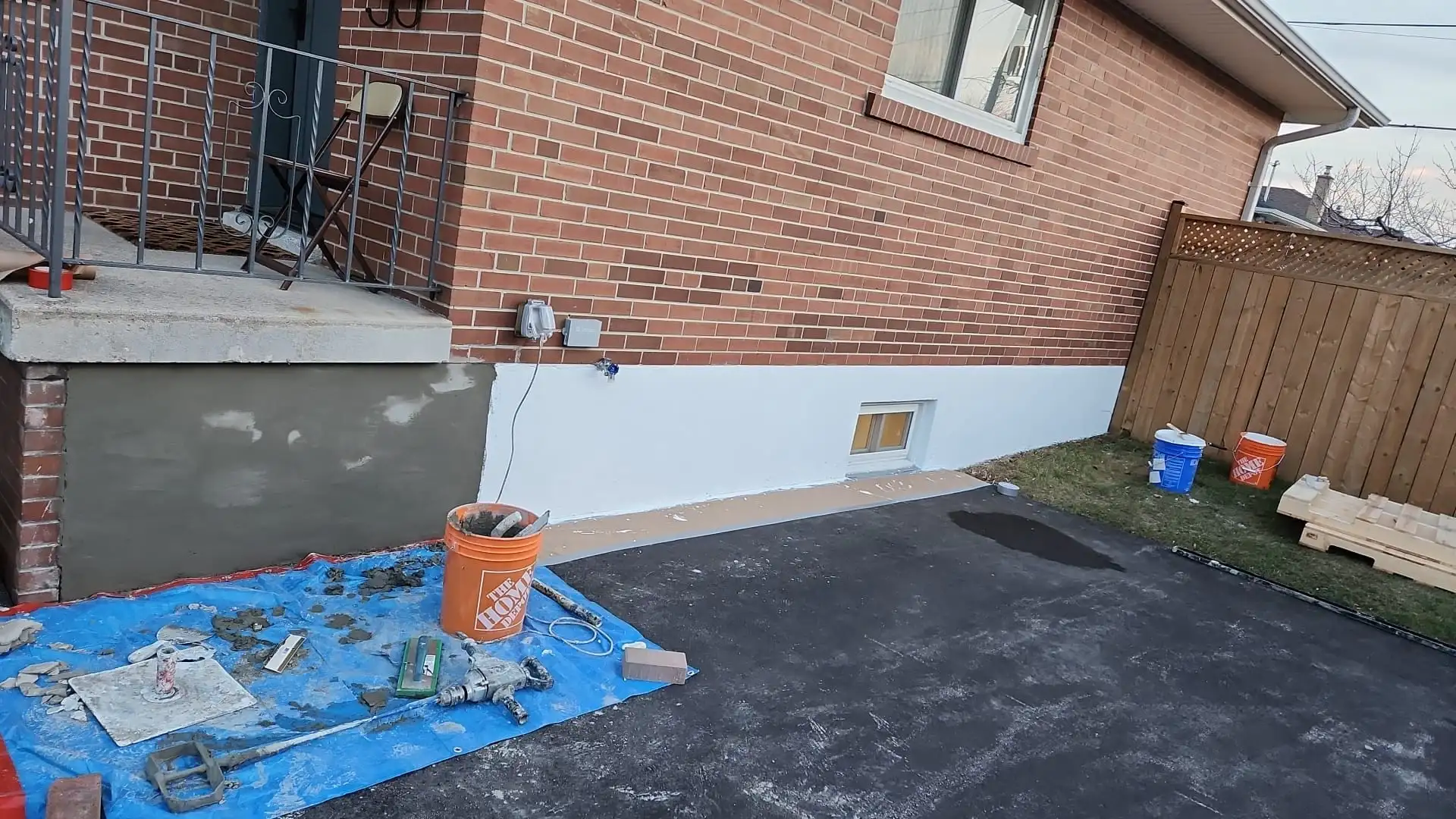
In most cases, foundation crack repair and parging repair are done as a combined scope. If your foundation has multiple crack locations and deteriorating parging throughout, repairing individual cracks in isolation leaves an aging parging system around the repairs — which will fail independently over the next few seasons.
Full-perimeter parging replacement that incorporates crack repair into the scope typically produces a better 15–20 year result than piecemeal repairs, and the cost per square foot of comprehensive parging is lower than multiple individual crack repairs over time.
Parging repair services and pricing Parging cost guide 2026 Masonry repair for structural concerns
Concerned about cracks on your Toronto foundation?
We provide free on-site assessments with written condition reports.
FAQ